
Richland County Court Records After Arrest
After a Richland County arrest, the record path splits. Alvin S. Glenn Detention Center answers the custody question: whether the person is currently detained. The South Carolina Judicial Branch public index answers the court question: what case exists, what charges are filed, what bond or hearing entries appear, and whether the case has reached a disposition. Those two systems should be read together, but one should not be treated as a substitute for the other.
The Fifth Judicial Circuit Solicitor prosecutes criminal offenses in Richland and Kershaw Counties. The Solicitor's office describes its role as prosecuting citizens charged with criminal offenses in those counties, and Byron E. Gipson has served as Solicitor since January 9, 2019. In practical terms, that means a jail booking charge can be reviewed, amended, reduced, dismissed, indicted, or prosecuted under a different label after the arrest. For custody and booking details, use Richland County jail inmate records. For booking photos, use Richland County jail mugshots.
Find Richland County Court Records
The official local court lookup channel is the Richland County Public Index. Research access to the form was limited by timeout, so exact labels should be checked in a browser when precision matters. Still, the known route is clear: search the Richland public index by defendant name or case number, then read the docket events, charges, bond entries, hearing dates, and disposition fields shown for the case.
The official Richland County court index is the source screen for court records after a jail arrest.
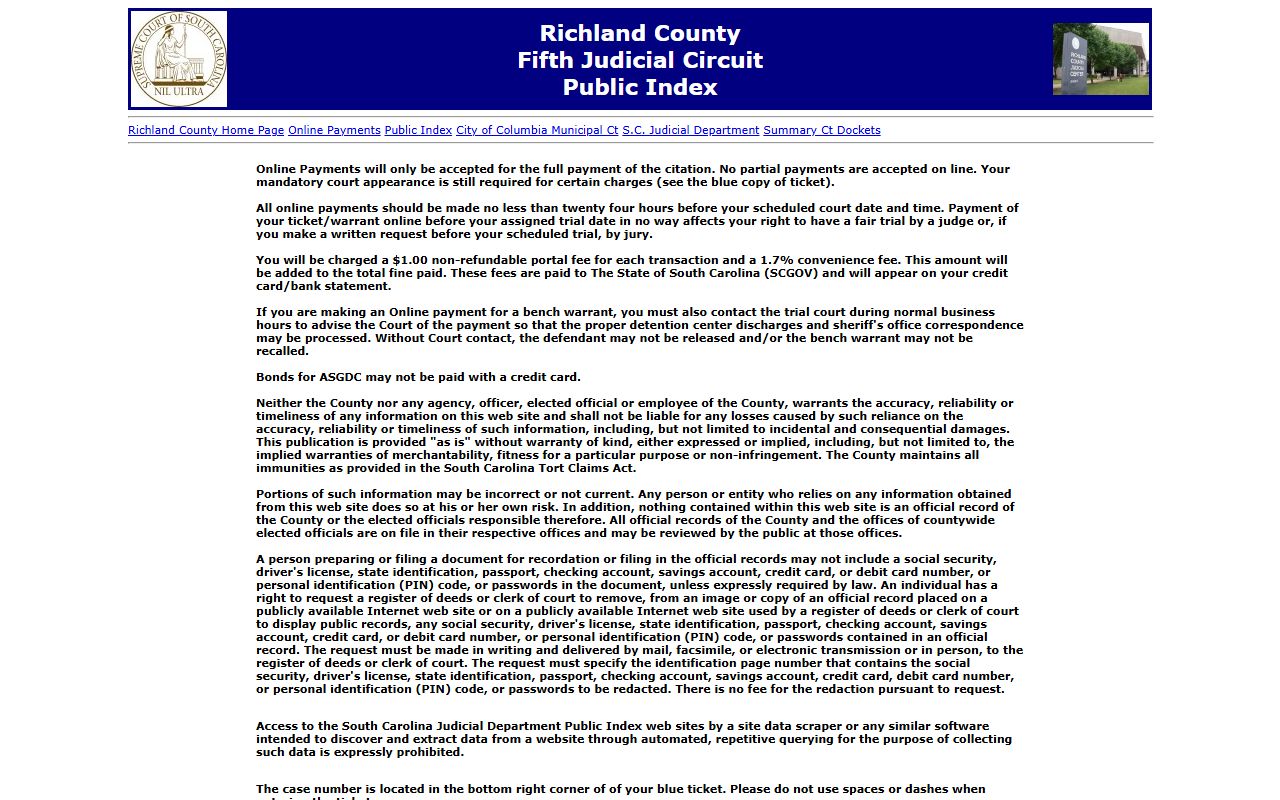
The public index screenshot helps separate the court-search path from the jail roster path used for current custody.
- Confirm current custody first through the county roster or the jail phone line when custody status matters.
- Search the Richland County Public Index by defendant name.
- Use a case number, court, date range, or charge filter if the public index offers those options and the name search is too broad.
- Open the case and compare the court charges with the booking or arrest charge names.
- Check each docket entry for bond, hearing dates, warrants, amended charges, disposition, or sentencing events.
- If no case appears, check whether the matter is still in intake, bond court, municipal court, magistrate court, sealed status, or not yet indexed.
| Field Label | Type | Required | Notes |
|---|---|---|---|
| County/Public Index selection | County portal | Yes by URL | The Richland portal is selected by the Richland Public Index address. |
| Party or defendant name | Text | Unspecified | Use name search when no case number is known. |
| Case number | Text | Unspecified | Use if obtained from jail, citation, warrant, solicitor, or court notice. |
| Date range or case type | Filter controls | Unspecified | Research could not verify the exact live labels. |
Charging Records After Arrest
A booking charge is not the final court record. It is usually the arrest or intake label based on law-enforcement paperwork. The case record begins to mature when the prosecutor or court files the formal charging document. In Richland County General Sessions cases, the Solicitor's review is important because the office may accept the charge, change it, drop it, or present it to a grand jury.
| Document | Who Uses It | What It Means |
|---|---|---|
| Complaint | Officer, court, or prosecutor depending on case type | Initial accusation or lower-court charging paper tied to the arrest. |
| Information | Prosecutor | Prosecutor-filed charge path that may be used when indictment is waived or not required. |
| Indictment | Grand jury and Solicitor | Formal charging document often used for serious General Sessions felony cases. |
When a court record after arrest lists several charges, read each line on its own. One count may be pending while another is dismissed. One charge may be reduced while another moves to plea, trial, or sentencing. That is why the court index is more reliable than a jail booking label for final case status.
Richland County Charge Status
Charge status shows where the court record stands after the arrest. Pending means the charge is unresolved. Amended or reduced means the legal label changed. Dismissed means the charge ended by court action. Nolle prosequi means the prosecutor declined to continue with that charge. Disposed means the case has an outcome, such as plea, trial verdict, dismissal, transfer, or diversion completion.
| Status | What It Means | Why It Matters |
|---|---|---|
| Pending | The charge has not reached a final outcome. | Bond, hearings, and court dates may still change. |
| Amended | The charge wording or code changed. | The court charge may differ from the jail booking charge. |
| Reduced | A less serious charge replaced the first charge. | Sentencing exposure and case meaning may change. |
| Dismissed | The charge ended by court action. | Dismissal is not the same as automatic expungement. |
| Nolle prosequi | The prosecutor declined to proceed. | It may support a later record-clearing request if eligible. |
| Bench warrant | A court issued a warrant, often for failure to appear. | It can lead to a new arrest and jail booking. |
Bond After Richland County Arrest
Bond is a court issue, not a jail decision. After a Richland County arrest, a magistrate or other judicial officer may address release at a first appearance or bond hearing. The jail holds the person under court orders and releases the person only when bond, paperwork, and any other holds are resolved. A roster entry may show that a person is in custody, but the court record and court staff are the better source for bond entries and hearing status.
| Bond Type | How It Works |
|---|---|
| Personal recognizance | Release based on a promise to appear, sometimes called PR or own recognizance. |
| Cash bond | Money is paid through an authorized court or jail channel when allowed. |
| Surety bond | A licensed bonding company posts bond for a fee when surety release is allowed. |
| Property bond | Real property may be used as security in some court-approved situations. |
| No-bond hold | No payment produces release unless the judge changes the order or another hold clears. |
| Detainer or hold | Another agency, county, probation/parole office, federal authority, or ICE may block release. |
Do not confuse bond with commissary money. Richland County publishes detainee-account deposit rules for commissary, including money orders and lobby kiosk deposits, but those rules are not bond-posting instructions. Call the court or jail before arrival if payment type, release timing, or a hold is unclear.
Warrants and Court Records
No official Richland County Sheriff active-warrant search page was confirmed in the reviewed sources. Before arrest, a warrant may exist only in court or law-enforcement systems. After arrest, the county roster becomes the custody lookup if the person is booked at Alvin S. Glenn. Bench warrants can be especially court-specific because they often arise from failure to appear or another violation of a court order.
For warrant questions, search the Richland Public Index for bench warrant or failure-to-appear activity, call the relevant court, contact RCSD at 803-576-3000 for sheriff-related warrant questions, or call Alvin S. Glenn at 803-576-3200 after a booking. Avoid commercial warrant sites when an official court or law-enforcement channel can answer the question.
Charges and Convictions Compared
A court record after a jail arrest may show accusations long before it shows any final finding. A charge is an allegation that moves through the court process. A conviction is a final result after a guilty plea, trial verdict, or other court outcome that creates guilt on the record. This difference is central when reading Richland County court records because arrest, charge, and conviction are separate stages.
| Issue | Charge | Conviction |
|---|---|---|
| Stage | Accusation after arrest or filing | Final guilty result by plea or verdict |
| Proof level | Based on accusation, probable cause, or charging decision | Requires court outcome under criminal proof standards |
| Can change | May be amended, reduced, dismissed, or not prosecuted | Can be appealed, vacated, pardoned, or later restricted only through legal process |
| Record meaning | Does not prove guilt | Shows a court result unless later changed by order |
Sealed and Expunged Records
South Carolina law allows some arrest and court records to be restricted or removed through court process. Section 17-1-40 is important for arrest-record and expungement-related rules, and Section 17-22-910 is used for eligible diversion or dismissal pathways. Eligibility depends on the charge, outcome, prior record, waiting period, and court order. A dismissed charge is not always hidden from public view the same day the case ends.
| Issue | Sealed | Expunged |
|---|---|---|
| Public view | Hidden or restricted from ordinary public access. | Removed or treated as cleared under the expungement order. |
| Who may still see it | Some courts or agencies may retain limited access. | Access depends on the statute and order. |
| How it happens | Usually by court rule or order. | By eligible petition, fee/process if any, and court-approved expungement. |
| Effect on jail records | May require separate agency action. | Record holders may need the order to update or remove related public material. |
For a Richland County arrest, keep certified court paperwork. Agencies may need the order before limiting a booking record, correcting a public entry, or removing a photo from an official channel.
Restricted Richland County Records
South Carolina FOIA gives access to public records, but Section 30-4-40 lists exemptions. A court record after arrest may be limited because the case involves a juvenile, an active investigation, privacy-protected material, victim information, sealed filings, medical or mental-health details, jail security information, or a separate statute. Court records can also be delayed when a case has not been filed or indexed yet.
Important: Richland County court records should not be used as a consumer report for employment, credit, insurance, housing, or tenant screening decisions.
Note: If a name search fails, check spelling, case timing, court level, and whether the record is sealed or expunged.